
Malabar Whistling-thrush
Myophonus horsfieldi

Derek Edwards’s Bird of the Week is a feature of A Running Commentary, new editions of which can be found every Monday most Mondays at www.edwardsedition.com/newsletter. This Substack features reprints of classic entries for a wider audience.
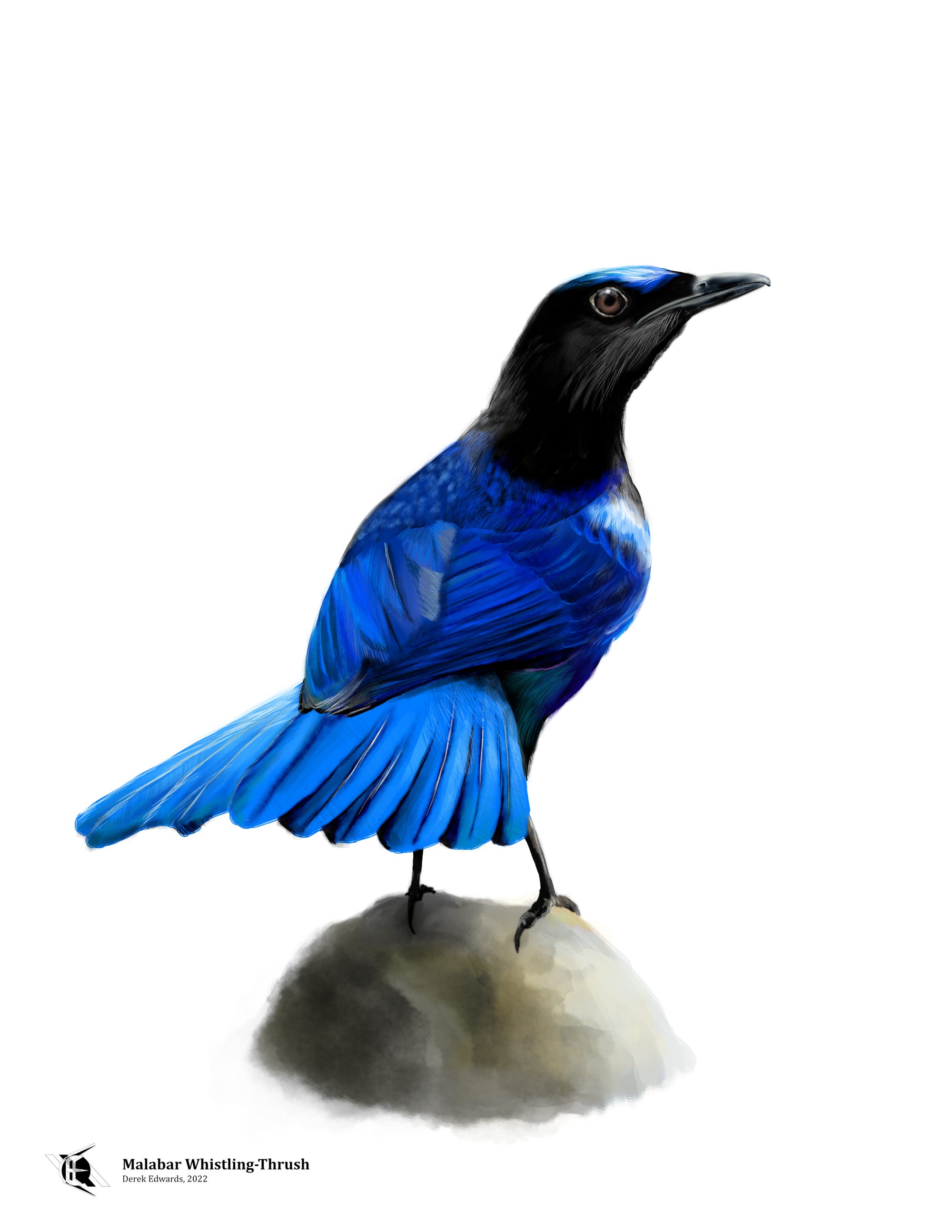
This week we're featuring an odd little bird from South Asia. The Malabar Whistling-Thrush is found in the hilly country along the western coast and across the upper boundary of peninsular India. Whistling-thrushes, of which there are nine species, all within the same genus, distributed throughout Asia, are primarily ground-dwelling songbirds, nesting on ledges or low branches and feeding on ground- or water-dwelling invertebrates. The Malabar whistling-thrush is particularly dependent on forest streams, as they feed almost exclusively on aquatic insects and snails.The whistling-thrushes are not, in fact, thrushes. While they were initially believed to be thrushes, they are now classified within the Old World Flycatcher family. (While we got better buntings and warblers, the Eastern Hemisphere definitely got the better flycatchers.) To me, they look most like starlings, what with their sharp faces and glossy feathers. Those feathers are actually the focus of considerable study. These birds see each other quite differently from how we see them; nearly all of a whistling-thrush's coloration is in the ultraviolet spectrum, and their blue color is only visible under the right lighting conditions.
Whistling-thrushes may not be thrushes, but they do whistle. Their songs are low, meandering melodies that sound eerily like the whistling of a human being. In India, the Malabar whistling-thrush is sometimes nicknamed the "whistling schoolboy". "Malabar" (not to be confused with "mallowbar", a similarly-named bar cookie) is a reference to the Malabar coast, a stretch of shoreline between the Western Ghats and the Arabian Sea that makes up part of the bird's range. The word derives from Arabic and was long used by foreigners to refer to what is now the Indian state of Kerala. To science, the bird is Myophonus horsfieldi, or "Horsfield's fly-slayer", so named in honor of Thomas Horsfield, a Pennsylvanian naturalist and friend of Benjamin Franklin who cataloged many species native to Indonesia, but who never traveled to India.